
What a Real CRO Guarantee Should Promise You
Most CRO guarantees are written so they never have to pay out. The fine print never says what "improvement" means, on what traffic, read by which tool, against what page. A real cro guarantee has to answer four questions before anyone signs anything: what metric, what threshold, what traffic, and what platform reads the result. Ours is a flat $2,500 page rebuild with a 10% lift in revenue per visitor in a controlled test, or your money back, for up to five test iterations.
Why most guarantees can never be proven wrong
A guarantee that says “we will improve your conversion rate” is not a promise, it is a mood. Improve by how much? Measured how? Against what? Without those four answers, the agency can always point at something that moved and call it a win, and you can never call it a loss. That is not a guarantee, it is marketing copy wearing a guarantee’s clothes.
The fix is not complicated, it is just specific. State the metric. State the number. State the traffic source and the tool that reads it. If any one of those is missing, the guarantee is decorative.
The metric has to be one a discount cannot fake
We guarantee revenue per visitor, not conversion rate, because conversion rate can be won by cheating. Push a cheaper product forward, run a coupon, and conversion rate climbs while the business earns less per order. Revenue per visitor is total revenue divided by total visitors, so a discount that buys more orders shows up directly in the number. It cannot be gamed by making the offer worse to make the chart look better.
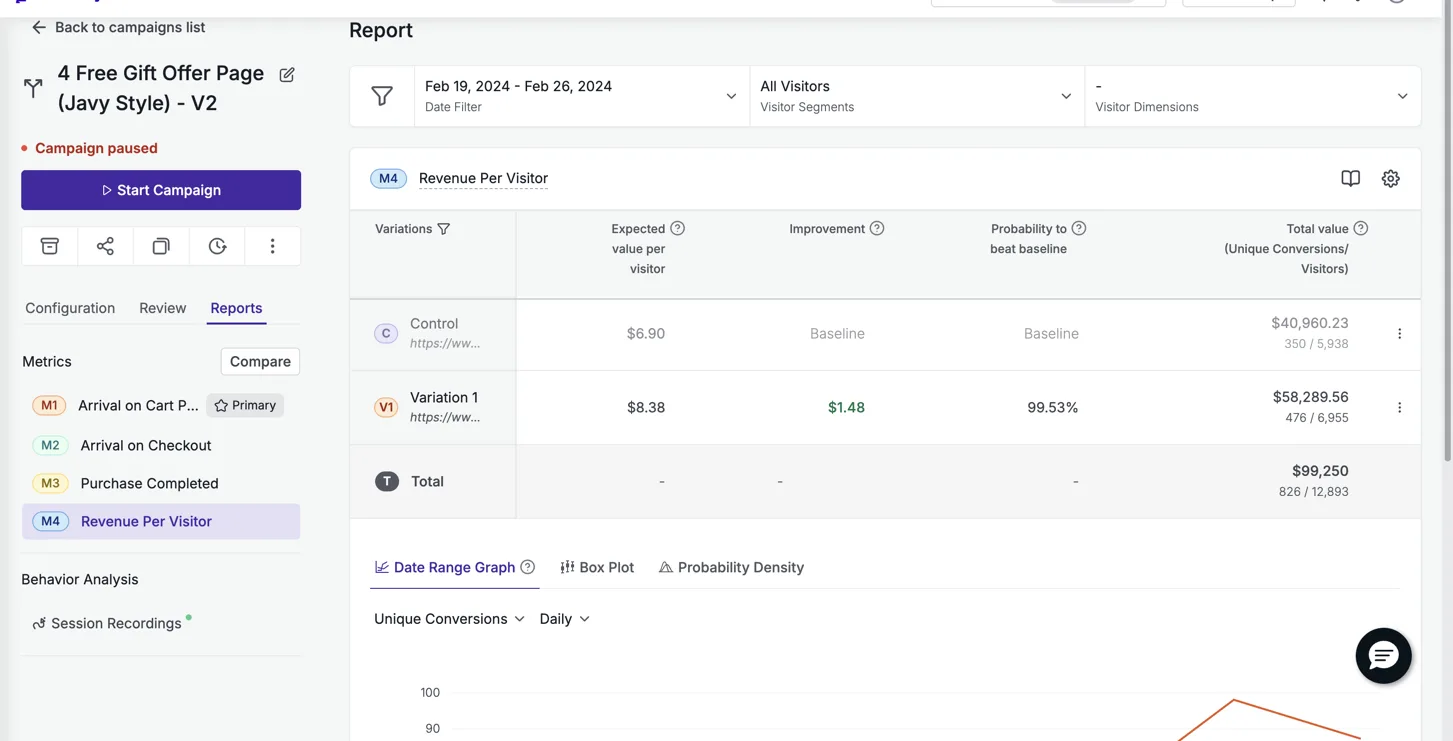
Every result we publish is the new page against the brand’s own current page, split on their own live traffic, read straight from the A/B testing platform. Never ad platform reported revenue, which attributes generously and cannot see what the page actually did. On Particle for Men, that discipline read plus 21.4% revenue per visitor, offer page against their product page, on VWO, at 99.5% confidence across 12,893 visitors. It has stayed live for two years.
Where the lift actually comes from, in order
A guarantee is only honest if it is attached to a method that can reliably hit it. The size of a win is mostly decided before anyone writes a headline, and it comes down in this order.
- What the visitor lands on. An ad for one product landing on a home page or a broad collection makes the visitor hunt for what they came for. Most will not bother.
- What kind of page it is. A product page describes a product. An offer page argues for buying it right now. Those are different jobs, and they convert differently.
- How the page is built. Real, and the level most brands stop at, but a smaller lever than the two above.
- Single element changes. Button color, badge wording. At this scale, close to noise.
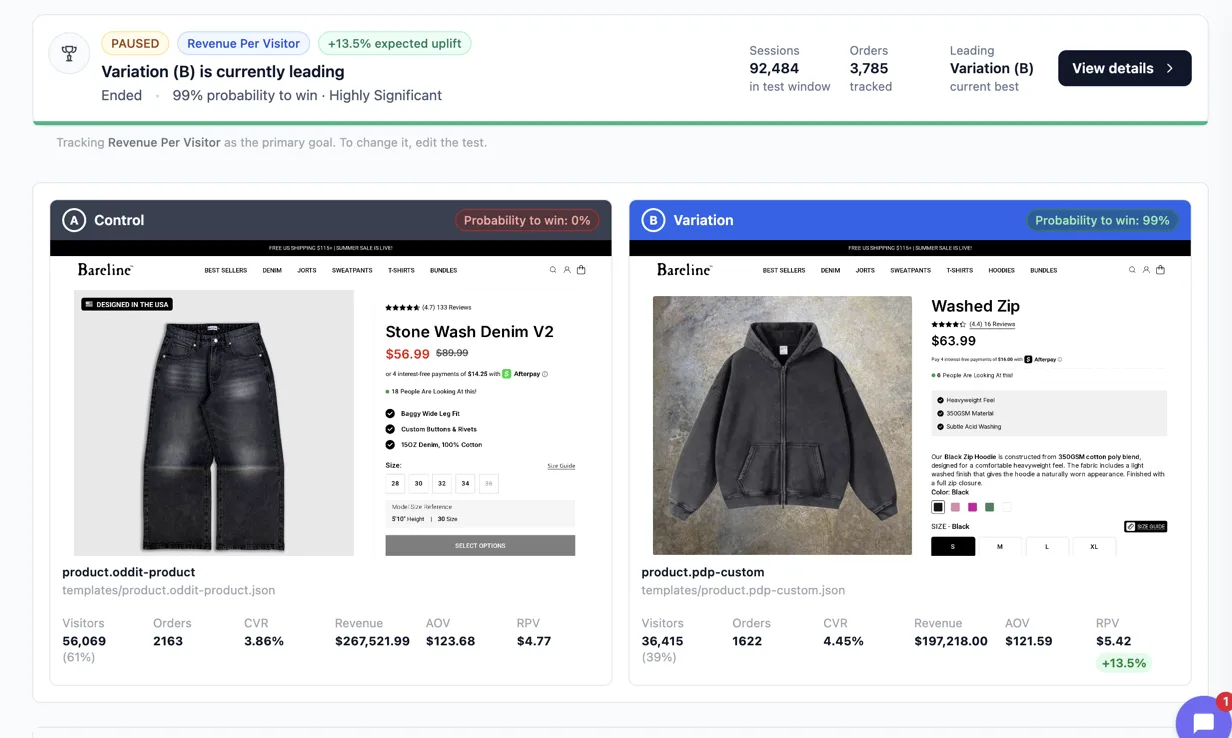
Bareline is the clean proof that structure beats surface polish. We ran our product page template against their existing template, sitewide, across 92,484 sessions on Eraya. Plus 13.5% revenue per visitor, at 99% probability to win. Nobody touched a button.
The offer is the part most pages get wrong
Most rebuilds jump straight to layout. The bigger lever, especially on a consumable or subscription product, is the offer itself. Three choices, not two, with the middle tier visually favored, a genuine one time option shown small to make the other two look smart, and unit price beside every tier so a big number gets divided down to something a visitor can compare. A struck through price only works if it was a real price. Stacking free items against a discount often beats a deeper discount outright, because the buyer is doing addition, not subtraction.
None of this works if the guarantee cannot be checked. Specify the metric, the threshold, the traffic, and the platform, or it is not a guarantee.
Eiyan Lens is a case where the page type mattered more than any single tweak. We tested an offer page against their own home page, on Google Ads traffic, in ABConvert. Plus 52% revenue per visitor. That gap is not decoration, it is a different job for the page to do.
What we will not do to hit the number
A guarantee this specific creates a temptation to cheat it, and that temptation is where most agencies quietly fold. We do not invent proof that is not there, we do not carry one brand’s numbers onto another brand’s page, and every percentage claim on a page has to trace back to something real about that brand. If the proof is thin, the page runs shorter. It does not get padded with invented reviews.
We have worked with 400+ ecommerce brands. Fifteen of those have a measured, controlled test result we can point to, and every one of them is on /results/. That is the honest split: relationships are one number, proof is a different, smaller one, and a real cro guarantee never blurs the two together. If you want to see exactly what we promise and what triggers the refund, the full terms are on /guarantee/.
See it on your own page.
We rebuild your highest-leverage page and prove the lift on your own live traffic. A 10% lift in revenue per visitor, or your money back.
Book a call